Instructional Design & Plain-Language eLearning
Getting Organized for Legal Help: First Steps Learning Module
Created a concise eLearning module in Articulate 360 to help individuals prepare for their first legal consultation, covering what documents to gather, key questions to consider, and how to communicate effectively with an attorney.
Responsibilities
Learner Needs
Identified key learner needs for individuals preparing for a first legal consultation.
Learning Objectives
Defined learning objectives focused on practical preparation steps before meeting with an attorney.
Plain-Language Structure
Structured module content for a general, non-specialist audience with no prior legal knowledge assumed.
Instructional Content
Developed plain-language instructional content in Articulate 360 to reduce stress and improve clarity.
Interactive Activities
Designed interactive checklists and scenario prompts to help learners organize documents and questions.
Accessibility Review
Reviewed and refined the module based on accessibility, readability, and clarity standards.
Overview
Helping first-time legal help seekers feel prepared before a consultation
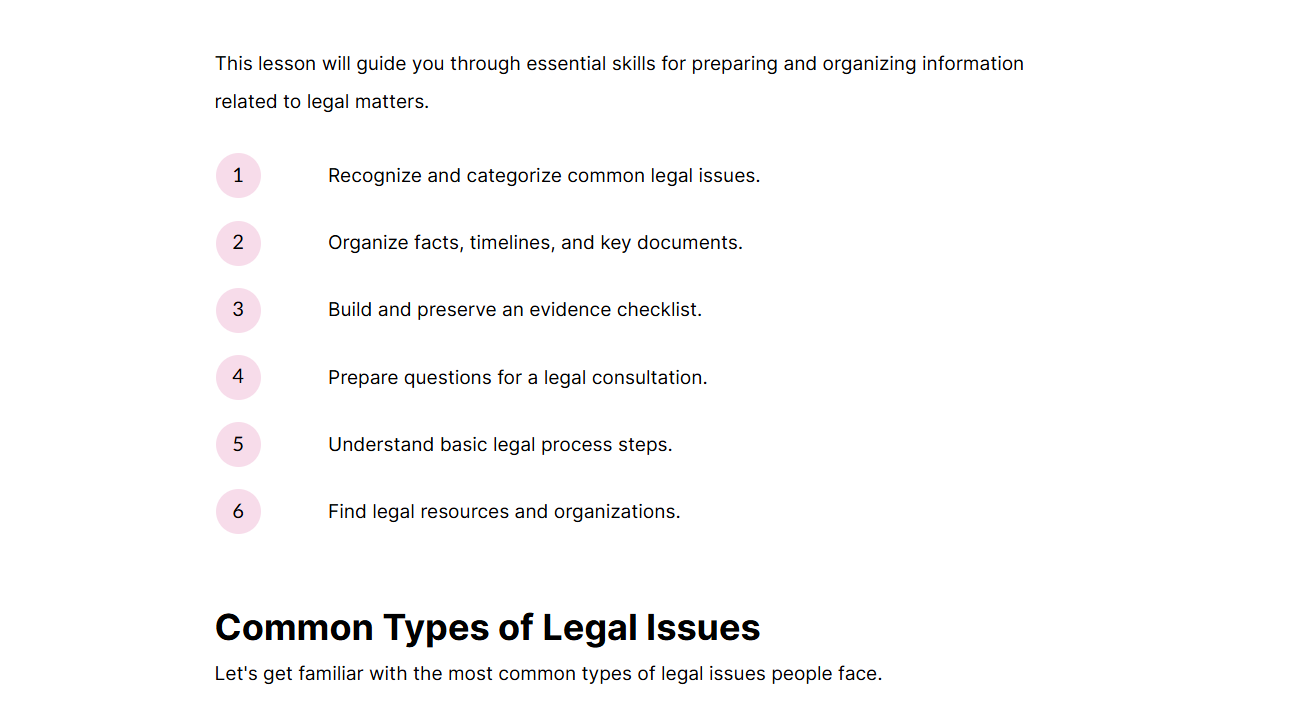
This learning module is designed for individuals seeking legal advice for the first time who are unsure how to prepare.
The module walks learners through practical preparation steps, including what documents to gather, how to organize a timeline, and how to identify useful questions before meeting with a lawyer.
Service Value
Reducing consultation stress through practical preparation
The value of this project comes from helping learners arrive at a legal consultation with clearer documents, a basic timeline, and more focused questions. The module supports better communication between individuals and attorneys while reducing confusion during an already stressful process.
Short sections covering what to bring, building a timeline, and questions to ask.
Minute maximum completion time designed for a short, accessible learning experience.
Flesch-Kincaid grade-level target applied to instructional copy for readability.
Problem & Goals
Making the first legal consultation less confusing and more productive
People navigating legal situations for the first time often do not know what to bring, what to say, or what questions to ask.
This lack of preparation can lead to incomplete consultations, higher costs, and increased anxiety. The goal was to demystify the preparation process and help learners organize information before meeting with an attorney.
Document Readiness
Help learners identify documents, correspondence, identification, and records that may be relevant to their situation.
Timeline Clarity
Guide learners through creating a simple written sequence of events before their appointment.
Better Questions
Support learners in identifying what they need to ask the attorney and what information the attorney may need from them.
User Scenario
Need Legal Help
A learner is preparing to speak with an attorney for the first time and feels unsure about what to expect.
Gather Documents
The learner identifies documents, messages, notices, records, or identification that may help explain the situation.
Build a Timeline
The learner organizes key events into a simple sequence so the attorney can understand what happened.
Prepare Questions
The learner writes down questions about next steps, costs, deadlines, risks, and what information the attorney needs.
Attend Consultation
The learner arrives more organized, communicates more clearly, and uses consultation time more effectively.
My Role
Designing a plain-language learning sequence for a broad public audience
As the instructional designer, I identified the key informational gaps that first-time legal consultation seekers face and structured those needs into a brief, plain-language module.
I wrote all module content, designed the interactive checklist activities, and developed the full module in Articulate 360 with accessibility and plain language as guiding principles throughout.
First-Time Legal Help Seeker
Learner preparing for a legal consultation
This learner may feel overwhelmed and needs simple, practical guidance on how to prepare before meeting with an attorney.
Goals
- Know what documents to gather
- Explain the situation clearly
- Ask useful questions during the consultation
Community Support Organization
Potential legal aid, library, or nonprofit partner
This organization needs a simple resource that can help community members prepare before seeking legal assistance.
Goals
- Improve access to legal information
- Reduce confusion before consultations
- Share a self-paced preparation resource
Discovery & Constraints
Creating a helpful module that works across different legal situations
Content development drew on commonly available public legal resources, self-help legal guides, and general patterns of what attorneys often request from new clients.
The primary constraint was audience breadth. The module needed to be relevant across different types of legal situations, including family law, landlord-tenant, employment, and estate matters, without becoming too general to be useful.
Broad Audience
The module needed to support many legal situations without giving situation-specific legal advice.
Plain Language
Content needed to remain accessible for learners with different reading levels and comfort with legal terms.
Practical Focus
The module needed to emphasize preparation steps learners could complete before a consultation.
Key Features
Interactive Document Checklist
The checklist activity allows learners to mark off document types that may be relevant to their legal situation before meeting with an attorney.
Timeline Reflection Prompts
Reflection prompts guide learners in organizing key dates, events, notices, conversations, and decisions into a simple written timeline.
Printable Preparation Checklist
The module closes with a printable checklist learners can bring to their consultation or use as a final preparation guide.
Information Architecture & User Flows
Structuring the module around the first consultation preparation process
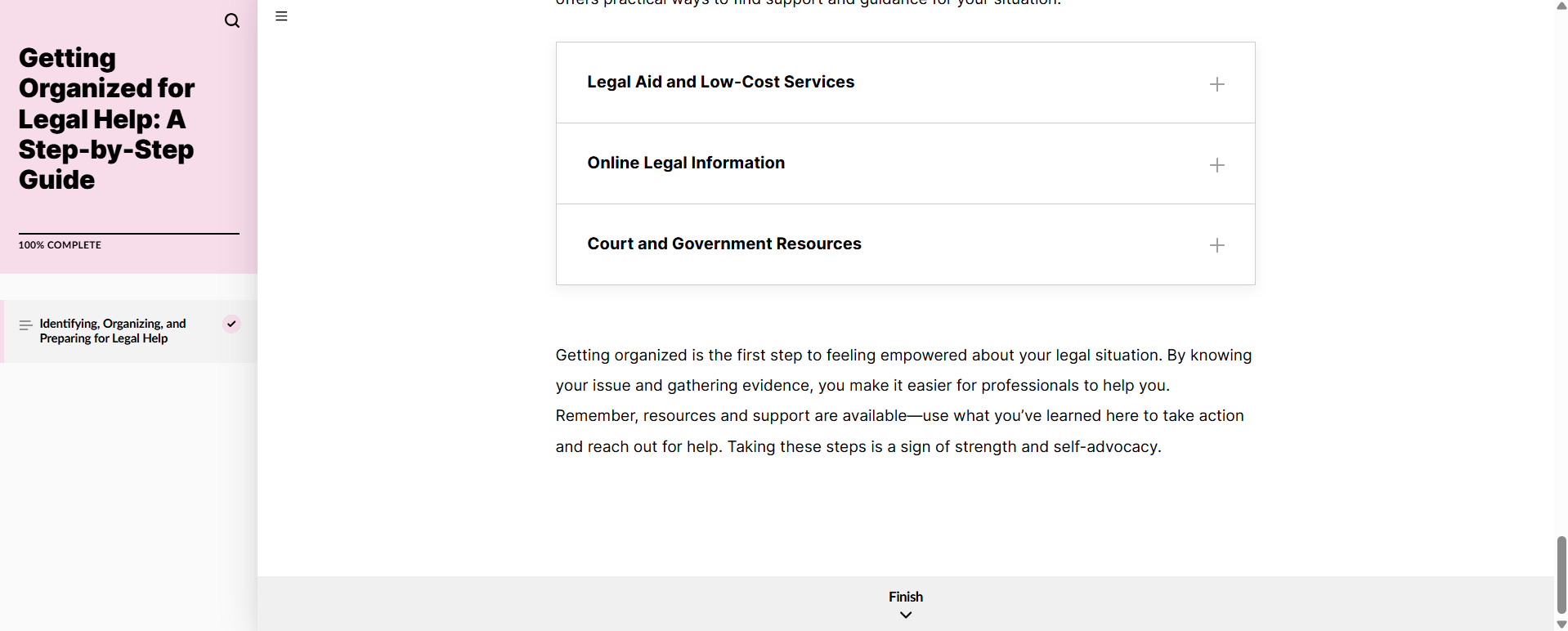
The module is organized into three short sections: what to bring, building your timeline, and questions to ask.
The learner moves through the sections in sequence, completing a brief reflection prompt at the end of each section before reaching the printable preparation checklist.
Primary Learner Flow
What to Bring → Interactive Document Checklist → Building Your Timeline → Questions to Ask → Printable Preparation Checklist → Completion
Wireframes & Prototypes
Storyboarding each screen for readability and accessibility
A storyboard outlined each screen’s content, interaction type, and plain language review notes before development in Articulate 360.
The storyboard was reviewed for readability and accessibility, with a Flesch-Kincaid target of Grade 6–8 applied to all instructional copy.
Requirements & Acceptance Criteria
Making legal preparation accessible to non-specialist learners
The module was designed to be completable in under 15 minutes with no prior legal knowledge assumed.
Accessibility requirements included keyboard-navigable interactions, alt text on all visual elements, sufficient color contrast, and screen reader compatibility. Plain language criteria were applied to every content screen.
Analytics, Iteration, Outcomes & Next Steps
Improving clarity through plain-language review
The module was reviewed for plain language compliance and clarity by a peer with no legal background.
Feedback produced one revision cycle that simplified the document-gathering section and added brief explanatory notes for legal terms that could not be entirely avoided.
Develop a Spanish-language version for Spanish-speaking community members.
Explore integration with local legal aid referral resources.
Share the module with legal aid organizations, public libraries, and community nonprofits.
Next Steps
Next steps include developing a Spanish-language version to serve Spanish-speaking community members and exploring integration with local legal aid referral resources.
Future iterations could include legal topic-specific versions for landlord-tenant, employment, family law, estate planning, or consumer protection situations.
Learnings
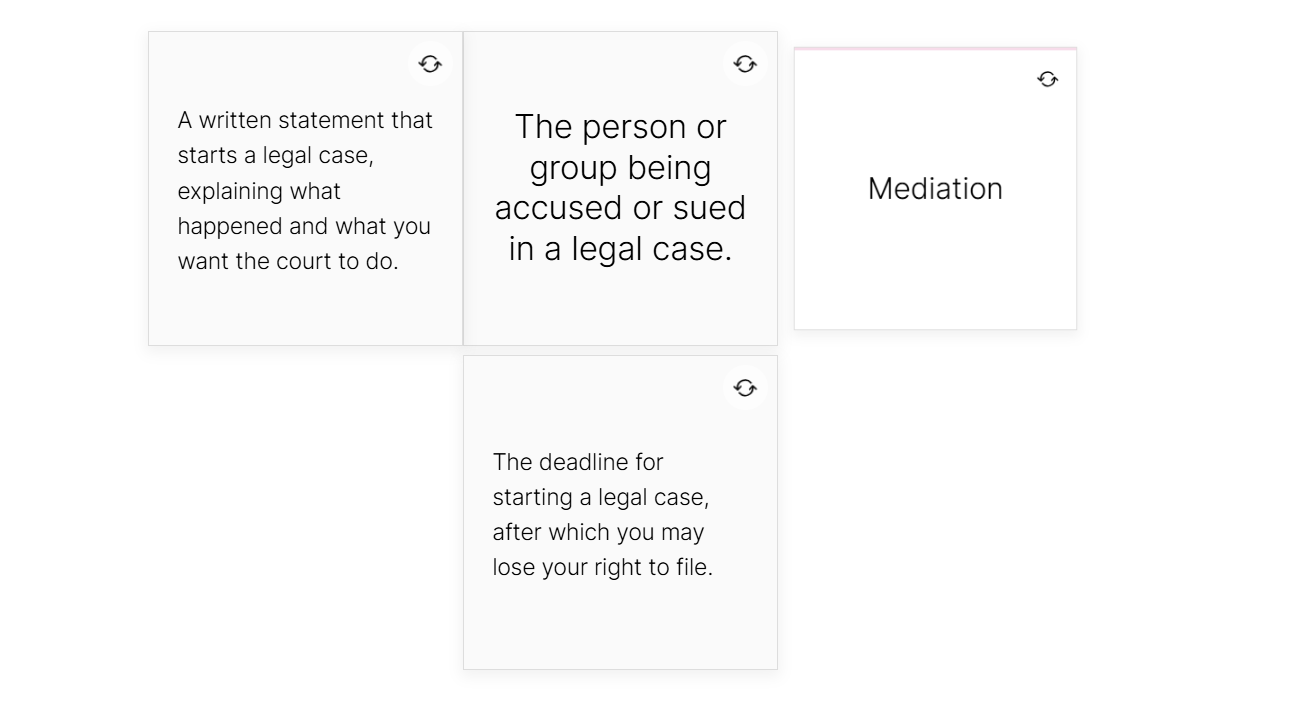
This project strengthened my ability to translate complex legal preparation concepts into plain-language instructional content for a broad public audience.
I also learned how important it is to design legal information resources around practical preparation, accessibility, and learner confidence rather than assuming prior legal knowledge.